COMPANY / RESEARCH / ARTICLE

AppliedXL Partners with Kalshi on Resolution for Biopharma Prediction Markets

The pilot introduces contracts tied to selected clinical trial outcomes and FDA decisions, with resolution based on predetermined public sources and documented criteria.

17 JUL 2026 · APPLIEDXL · 4 MIN
Kalshi and AppliedXL logos side by side on a black background

AppliedXL and Kalshi today announced a pilot partnership focused on prediction markets tied to selected clinical trial outcomes and FDA drug decisions.

Kalshi, a CFTC-regulated designated contract market, will operate the markets and remains the sole and final adjudicator of every contract under its exchange rules. AppliedXL will serve as Kalshi's independent resolution-analysis partner, supporting market selection and providing analysis based on predetermined regulatory and clinical sources. AppliedXL will not make the final settlement decision.

Each contract asks a defined question, such as whether the FDA will approve a specified drug by a particular date. A contract trading at $0.72 can be interpreted as a market-implied probability of approximately 72%, based on current trading activity.

That price is not a clinical assessment, medical guidance, or a substitute for scientific evidence. It is a changing expression of what market participants collectively expect at a given point in time.

Forecasts about drug development are commonly produced by financial institutions, industry participants, researchers, and specialist analysts. Many remain private, while parts of the public clinical record are incomplete or delayed. In April 2026, the FDA reported that 29.6% of studies it considered highly likely to be subject to mandatory reporting requirements had no results information submitted to ClinicalTrials.gov.

The pilot will examine whether carefully designed markets can provide an additional, publicly visible measure of expectations around drug development. They are intended to complement clinical evidence, regulatory judgment, and independent analysis.

Because these contracts concern medicines, patients, and companies with access to sensitive information, they require a higher degree of care. The pilot is therefore beginning with a limited scope and a framework centered on verifiability, market integrity, conflicts of interest, and potential effects on patients and clinical research.

"Drug development involves substantial uncertainty, and important information is often fragmented across technical and regulatory sources. This pilot is intended to test whether carefully structured markets can make expectations more visible while maintaining clear compliance and market-integrity standards. We are beginning with a limited scope and expect to refine the program as we learn." — Tarek Mansour, CEO, Kalshi

How potential markets are evaluated

Not every clinical or regulatory event is suitable for a prediction market.

Before recommending a market for listing, AppliedXL evaluates whether the question can be answered objectively, whether the relevant evidence is expected to become public, and whether the contract presents material ethical or market-integrity concerns.

AppliedXL's role in this process is advisory. Kalshi decides which markets are listed and retains final authority over all listing decisions under its exchange rules.

The review considers the clarity and clinical relevance of the outcome, the availability of an independent public resolution source, patient recruitment status, the vulnerability of the affected patient population, and the possibility that a small group could influence the event or possess material nonpublic information.

It also considers whether public records may be delayed, corrected, incomplete, or inconsistent.

Where recruitment considerations are relevant, the pilot will generally prioritize trials that have completed enrollment or circumstances in which the contract is unlikely to influence patient participation. Markets involving unusually sensitive patient populations or outcomes that cannot be separated from individual patient welfare may be excluded.

These criteria are part of an initial framework and will be reviewed as the pilot develops.

Defining the outcome in advance

Each contract identifies the question, deadline, resolution criteria, and source, or hierarchy of sources, that will be used to determine the outcome.

Depending on the contract, sources may include an FDA database or action document, a ClinicalTrials.gov results record, an advisory committee record, or another official source named in the contract rules.

The meaning of YES and NO is established before trading begins. The criteria are not revised in response to how a result affects either side of the market.

Some regulatory and clinical outcomes are more complicated than a single announcement. Information may be released in stages, records may be corrected, and different public sources may appear to conflict. The contract terms therefore need to address source precedence, publication delays, corrections, ambiguous results, and circumstances in which a market should be postponed or cancelled.

The official Kalshi contract terms and exchange rules govern in every case.

How resolution analysis works

Clinical trial and regulatory results are often distributed across several public records and released over time. Press releases may summarize an outcome before the underlying clinical or regulatory documentation becomes available.

AppliedXL monitors the public sources identified in the contract and detects information that may trigger resolution. Its systems organize the relevant documents and compare the reported outcome with the contract's predefined criteria.

A human reviewer then examines the evidence, checks the interpretation against the contract language, and documents the basis for the proposed resolution. Where the evidence is incomplete or contradictory, the matter is escalated for additional review rather than resolved solely through automation.

AppliedXL submits its resolution analysis and supporting evidence to Kalshi. Kalshi independently reviews that analysis and has sole authority to determine and finalize the outcome under its rules.

The objective is to create a documented process that can be reviewed, challenged through applicable procedures, and corrected when an authoritative source changes.

Market integrity and conflicts of interest

The credibility of the pilot depends on separating those who evaluate outcomes from those who could profit from them.

AppliedXL employees are prohibited by company policy from trading in prediction markets. AppliedXL will not take directional positions in the contracts it supports.

Kalshi's rules prohibit trading by people who possess material nonpublic information relevant to a contract or who have the ability to influence its outcome. Participants in these biopharma markets are also required to verify their employment, providing an additional control for identifying potential conflicts or access to nonpublic information.

Employment verification is one part of a broader compliance framework. Kalshi also conducts market surveillance and handles enforcement and disciplinary matters through its exchange procedures.

The division of responsibilities is intended to reduce conflicts. Kalshi designs and operates the markets and remains the sole and final adjudicator of each contract. AppliedXL provides market-evaluation support and independent analysis of the public resolution record.

"Clinical trial and regulatory results are rarely presented in a single, definitive document. Resolving a market requires tracing the evidence back to the primary source and evaluating it against criteria established before trading begins. That work also requires clear conflicts policies, human review, and a documented process for handling ambiguity and corrections." — Francesco Marconi, CEO, AppliedXL

A high level visual explanation of the resolution process is available in How a Fact Becomes a Settlement.

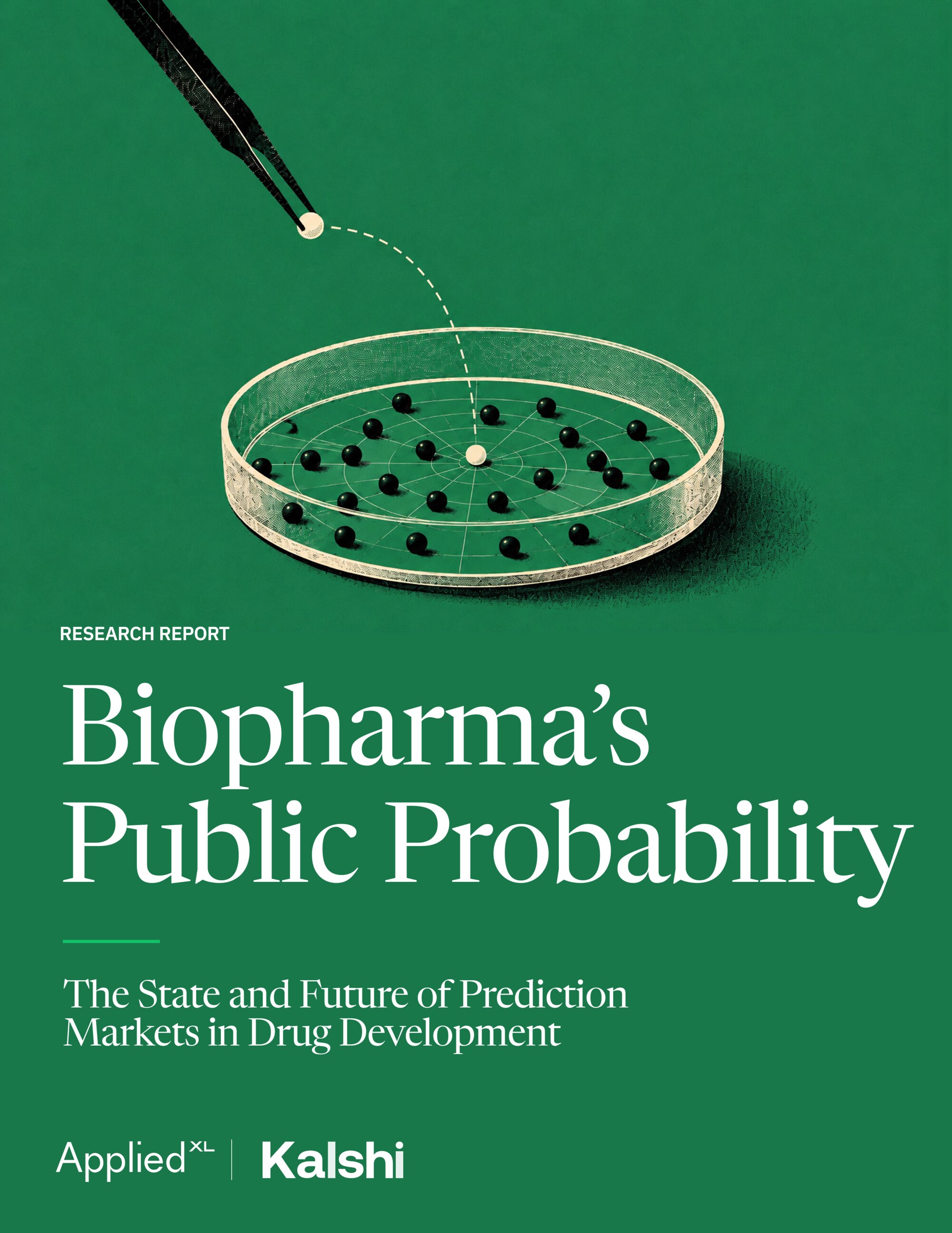
Biopharma's Public Probability

The report examines the potential uses of prediction markets in biopharma, the evidence supporting and challenging their use, and risks including insider trading, market manipulation, effects on patient recruitment, broader ethical concerns, and unreliable contract design.

It also proposes principles for market selection, resolution, transparency, and independent oversight. The report is intended as an initial contribution rather than a definitive standard.

As part of the pilot, AppliedXL and Kalshi consulted bioethicists, physicians, investors, and drug-development experts to identify potential risks and develop safeguards. Their perspectives, along with the research findings and proposed risk-mitigation strategies, are included in the report.

AppliedXL and Kalshi plan to update the framework as they receive feedback and evaluate the pilot's effects.

Biopharma News

AppliedXL is also launching Biopharma News, an open news service providing real-time coverage of clinical trial results, FDA decisions, and drug-development milestones, including events associated with selected Kalshi markets.

The service runs on the AppliedXL platform, which monitors institutional records and turns them into structured signals, forecasts, and verified outcomes. Its reporting is subject to editorial review and links readers to the underlying public sources.

Market prices reflect trading activity and can change rapidly. They should not be treated as medical advice, scientific consensus, or a recommendation to trade. Trading involves risk, and the official contract terms and Kalshi rules govern participation and settlement.

FAQQuestions about biopharma prediction markets?How the Kalshi–AppliedXL partnership works, how contracts get resolved against the public record, and the safeguards behind the markets.Read the FAQ
APPLIEDXL RESEARCH

See what the platform reads before it becomes news.

Source-linked intelligence across regulated markets, scoped to your domain.